Have you ever signed a transaction and only afterward realized the contract you approved could drain your tokens? That simple question reframes what a wallet is: not just a key store, but a risk-management interface. For advanced DeFi users in the US — traders, liquidity providers, and smart-contract operators — installation choices and feature trade-offs in a wallet shape daily operational risk. This article walks through installing Rabby, how its simulation and security stack work under the hood, how it compares to familiar alternatives, and where it breaks down so you can decide whether to adopt it in production workflows.
Rabby is not a generic consumer wallet. Built by DeBank as an open-source, non-custodial multi-chain wallet, it prioritizes pre-transaction simulation, approval management, and multi-sig / hardware integrations. That design philosophy changes the way you interact with dApps: you move from blind signing to an evidence-driven confirmation step. But the change introduces its own trade-offs — latency, complexity around edge-case simulations, and limits to fiat on-ramps — which I unpack below.
How installation flows differ and what matters for security
Rabby is available as a Chromium-based browser extension (Chrome, Brave, Edge), a mobile app for iOS/Android, and desktop clients for Windows and macOS. The installation decision should be driven by how you use dApps. If your work centers on desktop browser interactions with dexes and aggregators, the extension gives the tightest dApp UX; if you split activity between phone and desktop, use the desktop client plus mobile for monitoring, and keep a hardware wallet for signing.
From a security standpoint, installation vectors matter more than marketing. For browser extensions, the principal risks are supply-chain (malicious extension updates), profile corruption, and cross-extension interference. Best practice: install from official stores, enable auto-updates with caution, pin the extension, and pair it with a hardware device (Ledger, Trezor, Keystone, CoolWallet, GridPlus, BitBox02 are supported). Rabby’s hardware wallet compatibility is a major plus for operational security because it keeps private keys offline while allowing the simulation and pre-check engines to run in the host application.
Mechanics: transaction simulation, pre-transaction scanning, and approval revocation
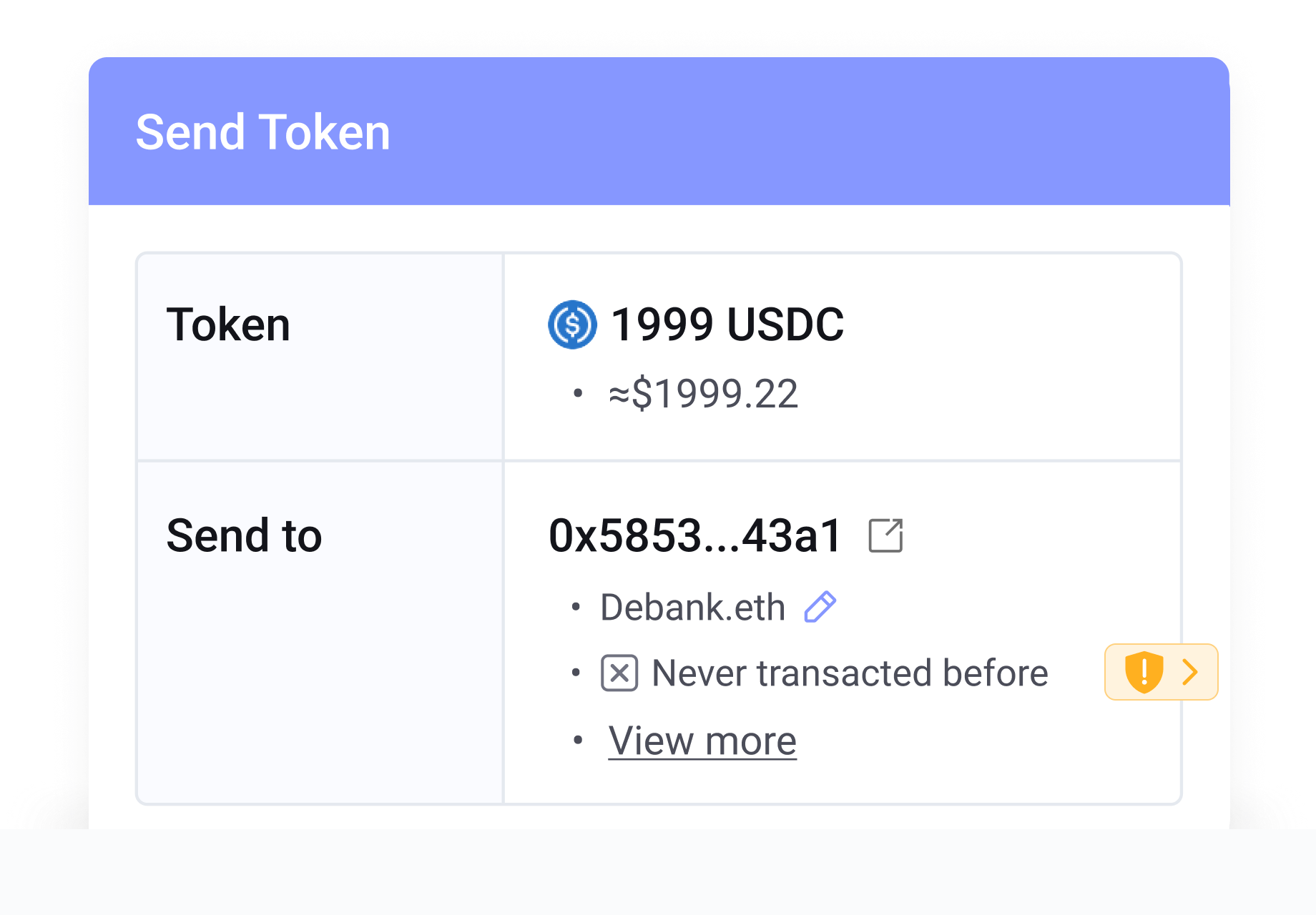
Rabby’s core defensive mechanism is a simulation-first workflow. Before you sign, the wallet simulates the transaction and shows estimated token balance deltas and explicit fee costs. Mechanistically, that means Rabby replays the intended call(s) in a sandboxed environment against an on-chain state snapshot and decodes the result into the user-facing summary. This is different from mere gas estimation: it attempts to show the actual economic effect of the transaction, including token transfers and approvals. For DeFi power users, that produces two immediate benefits: it reduces ‘blind signing’ and makes multi-step operations (for example, zap + swap) transparent.
Layered on top of simulation is a pre-transaction risk scanner. It flags known bad patterns: interactions with contracts tied to past exploits, suspicious approval amounts, or transfers to non-existent addresses. That scanner is only as good as its threat intelligence and heuristics. It will catch many common scams and recycled exploitable contracts, but it cannot reason about novel logic flaws or off-chain manipulations — so simulation and scanner together reduce, they do not eliminate, risk.
Rabby also provides a native approval revocation tool. After you grant allowance to a smart contract, you can inspect active approvals and cancel them from the UI. That reduces exposure to allowance-based drains, a common vector in ERC-20 token hacks. Operationally, power users should make this part of a routine: review approvals after large interactions and schedule periodic audits of long-lived allowances.
Where Rabby helps most (and where it is limited)
Best-fit scenarios: anyone interacting with many EVM chains (Rabby supports 90+ EVM-compatible networks), operators who use hardware wallets, and teams that require multi-sig or enterprise integrations (Gnosis Safe, Fireblocks, Amber, Cobo Wallet). The built-in automatic network switching reduces friction when a dApp expects you on a specific chain — useful when arbitraging across rollups or when tooling expects a chain-specific provider.
Limitations to weigh: Rabby does not provide a native fiat on-ramp, so US-based users who want to buy crypto with a debit/credit card must use third-party services and bridge funds in. There is also no native staking dashboard for running in-wallet staking operations for many protocols, so staking workflows often need external UIs. And while simulations expose many cases of malicious transactions, they can be imperfect for complex, state-dependent contract logic — especially if the simulation environment differs subtly from the live network during front-running, mempool reordering, or oracle-timed events.
Comparing Rabby to mainstream alternatives: trade-offs
How does Rabby stack up against MetaMask, Trust Wallet, and Coinbase Wallet? The primary differentiator is Rabby’s explicit transaction simulation and risk scanner. MetaMask is ubiquitous, well-integrated, and widely supported, but it lacks native pre-execution simulation at the same depth. Trust Wallet and Coinbase Wallet emphasize mobile UX and fiat rails (Coinbase especially) but provide fewer advanced anti-phishing primitives and less robust approval management. So the trade-off is clear: Rabby sacrifices built-in fiat convenience and some simplicity in return for stronger pre-signing visibility and tooling tailored to power users.
Another comparison axis is institutional readiness. Rabby’s integrations with multi-sig and custody providers make it more attractive for teams and small institutions that need governance controls. If you manage treasury funds or run a DAO, that compatibility reduces friction integrating your signing policy and audit trails into existing enterprise workflows.
Operational recommendations and a mental model for using Rabby
Decision heuristic: think of a wallet as a “risk filter” rather than simply a key manager. That shifts operational priorities — choose a wallet that filters the highest-consequence mistakes in your workflow. For most active DeFi operators in the US, the highest-consequence mistakes are wrong approvals, blind multi-step transactions, and signing with hot keys. Rabby directly addresses those by (1) simulating outcomes, (2) surfacing risky approvals, and (3) enabling hardware and multi-sig integrations.
Practical steps after installing Rabby: connect a hardware wallet for signing, import existing wallets cautiously (use seed phrase import only on an air-gapped or trusted machine), enable the approval revocation routine, and add the chains you commonly use. Use the ‘Flip’ toggle if you want to test switching between Rabby and MetaMask behavior in a controlled session. Finally, accept that simulation is a mitigation, not a panacea — you should continue using standard operational controls: limit high-privilege approvals, test transactions with small amounts, and maintain a separate signing key for experiments.
What to watch next — signals and conditional scenarios
Three near-term signals will matter. First, enhancements in off-chain threat intelligence (shared blacklists and behavioral heuristics) will improve scanners; watch whether Rabby expands partnerships with security firms or feeds into shared threat databases. Second, improvements in mempool simulation fidelity will determine how well simulators approximate front-running and sandwich risks — this is a technical frontier, not solved yet. Third, any movement toward integrated fiat rails could change Rabby’s appeal for mainstream users. If Rabby adds a KYC partner without compromising non-custodial principles, the product-market fit widens but also introduces regulatory complexity for US users to monitor.
Conditional scenario: if simulation engines begin incorporating probabilistic front-running models (a non-trivial engineering task), wallets that present expected slippage ranges under different miner behaviors will materially reduce surprise losses. Conversely, if regulatory pressure forces stricter KYC for wallet-integrated services, users who value privacy and autonomy may prefer modular stacks (separate custody and fiat on-ramps) over unified wallet solutions.
To try Rabby for yourself and follow setup guidance, see this resource on the official installation and features page: rabby wallet
FAQ
Is Rabby safe enough to use as a primary wallet for DeFi?
Rabby adds meaningful defensive layers — simulation, pre-transaction scanning, approval revocation, and hardware wallet support — which reduce risk compared with basic hot wallets. For high-value or institutional usage, pair Rabby with hardware signing and multi-sig governance. Remember: safety is layered. Rabby improves several layers but does not replace good key custody, operational discipline, or external audits of unfamiliar contracts.
Will Rabby prevent all smart contract exploits or rug pulls?
No. Rabby’s scanners and simulations detect many known bad patterns and can reveal obvious balance impacts before signing, but novel logic bugs, oracle manipulation, or time-dependent exploits can still create losses. Use Rabby as a decision-support tool, not an insurance policy.
How hard is it to install and migrate from MetaMask?
Installation is straightforward on Chromium browsers and desktops. You can import an existing seed phrase or private key, and Rabby’s ‘Flip’ toggle allows you to test it alongside MetaMask. Migrating keys requires care: always import on a secure machine and consider migrating incremental funds first to validate your workflow.
Does Rabby support hardware wallets and institutional custody?
Yes. It integrates with multiple hardware wallets and enterprise solutions like Gnosis Safe and Fireblocks. These integrations are why many teams consider Rabby for treasury and multi-sig workflows.
What should US users watch for in future Rabby updates?
In the US context, watch for added fiat on-ramps, any changes in KYC/AML posture, improvements in off-chain threat intelligence, and advances in mempool simulation fidelity. Each of these will affect convenience, regulatory exposure, and the practical accuracy of the pre-execution checks.
